

- Home
- Investors Centre
- Sustainability
- Talent
- News
- Insights
- TH!NK
- Corporate governance
- Who we are
- Board of Directors
- Community
- MCB Offices
Contact Info
Why Gold is not shining (yet) and when it will

Delving into gold’s recent retreat
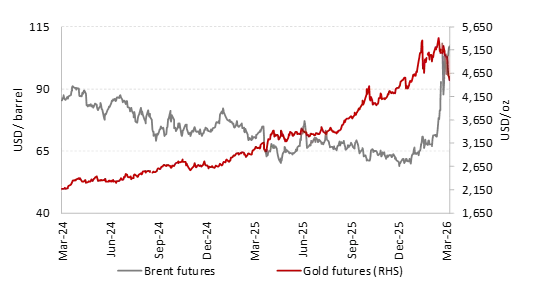
Gold has dropped by nearly 20% since the onset of US-Iran tensions, a move that runs counter to the rally typically expected in an environment marked by geopolitical stress.
However, this is not a classic flight-to-safety episode. The shock is not centred on recession or systemic collapse, but rather on energy prices and their implications for inflation and interest rates. As oil prices rise, markets are no longer focused solely on protection but they are instead repricing inflation risks. That shift is now pushing rate cut expectations further out and bringing a more hawkish policy path back into focus, creating a less supportive backdrop for gold.
Oil vs Gold: Revisiting the Inverse Relationship
Source: Investing.com
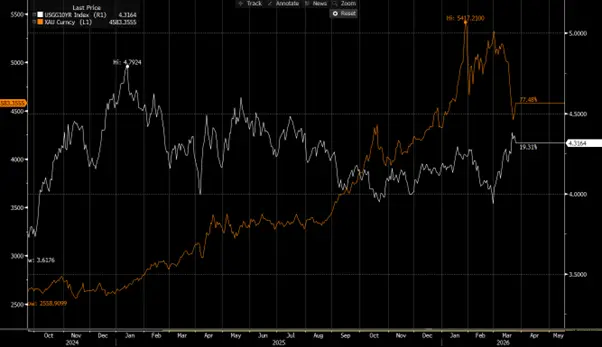
In this environment, gold faces a fundamental headwind. As a non-yielding asset, its attractiveness diminishes when interest rates remain elevated. At the same time, the US dollar has strengthened, supported by both safe-haven demand and yield differentials. Since gold is priced in dollars, this appreciation further weighs on demand. Part of that demand is also being channelled into digital dollars, with stablecoin market capitalisation recently reaching new highs. However, this does not displace gold’s role as a store of value, but it does reshape short-term liquidity dynamics.
Positioning has also amplified the move. Gold entered this episode after a strong rally in 2025, with positioning already elevated. Rather than attracting fresh inflows, the recent volatility has triggered profit-taking, position unwinds and a shift toward cash in a stronger dollar environment.
The Historical Playbook
History shows that gold rarely leads in the initial phase of a shock. During the 2008–2009 global f inancial crisis, gold initially declined as investors rushed into cash and the dollar surged, before rallying once monetary easing took hold. In 2020, gold dropped sharply at the onset of the pandemic as liquidity needs dominated, before rebounding to new highs as stimulus flooded the system. A similar pattern emerged in 2022 following the Russia–Ukraine conflict, where gold’s initial strength faded as inflation and rising real yields took centre stage.
The pattern is consistent: in the early phase of a shock, liquidity, the dollar and yields dominate; only later does gold reassert itself.
Source: Bloomberg
Gold is not weakening because geopolitical risks have diminished. On the contrary, it is struggling because market remains firmly in this initial phase defined by a stronger dollar, elevated real yields and delayed policy easing.
Outlook — Structural Strength, Cyclical Headwinds
Despite near-term pressures, the medium-term outlook for gold remains constructive, supported by three key pillars.
We expect the policy cycle to turn, with the Federal Reserve likely to begin cutting rates by September 2026. A decline in real interest rates would reduce the opportunity cost of holding gold and historically acts as a key catalyst for renewed upside.
At the same time, central bank demand remains robust. Global purchases are expected to remain strong in 2026, likely in the range of 850–950 metric tons, with recent moves such as Poland raising its gold reserve target signalling that institutional appetite remains firmly in place. Investment demand is also rebuilding, with ETF holdings rising toward historical highs, highlighting sustained investor interest even as prices consolidate.
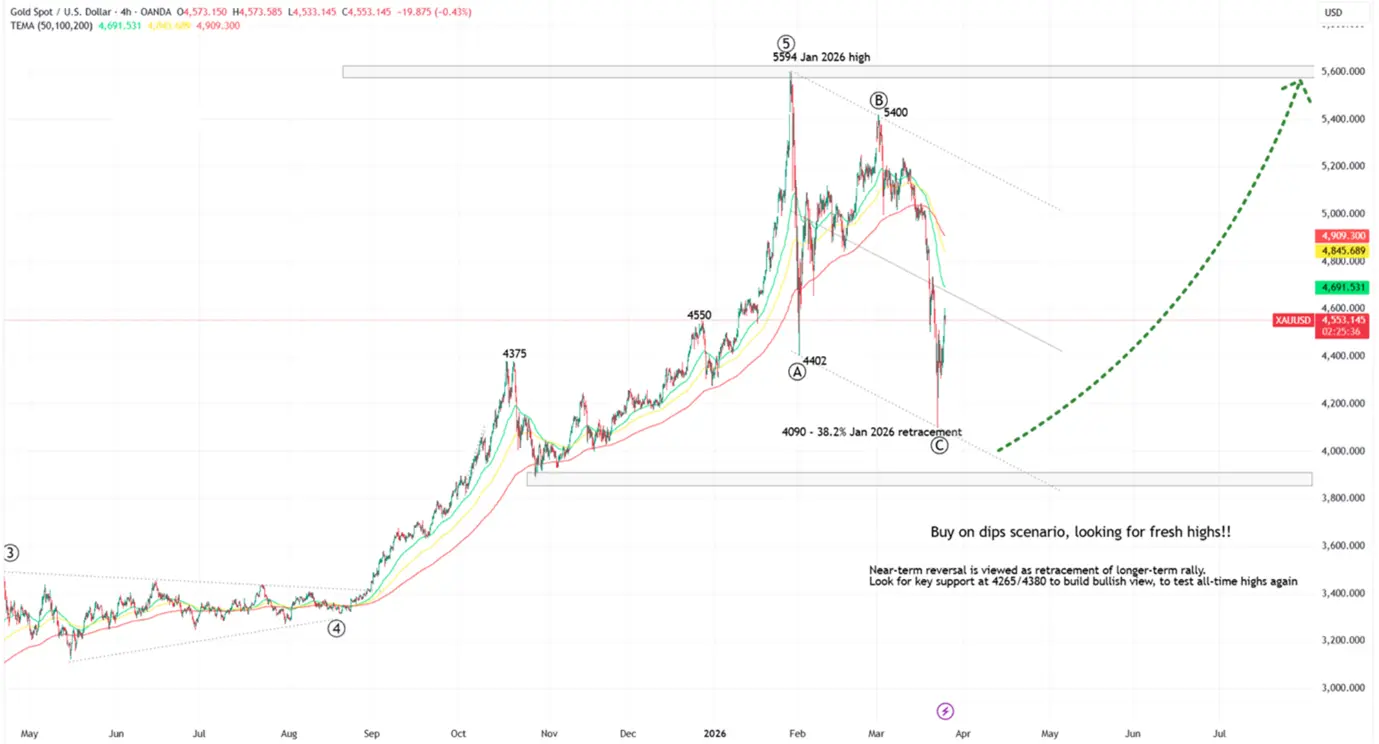
Taken together, these forces suggest that while gold may remain constrained in the near term by elevated yields, higher energy prices and a strong dollar, the conditions for a renewed move higher are steadily being put in place.
Against this backdrop, we see scope for gold to break above its January 2026 highs and move toward USD 6,000/oz by end-2026, assuming the expected easing cycle materialises, real yields trend lower and central bank purchases remain strong.
Source: MCB staff estimates
For more information, please contact MCB Global Markets Team on gmsales@mcb.mu
Published in collaboration with our Strategy, Research and Development team.
Disclaimer
“This publication is provided for general information purposes only and should not be construed as investment advice, a recommendation, an offer or solicitation to buy or sell any financial instrument or to participate in any trading strategy. The views and opinions expressed are those of the author(s) as of the date indicated and are subject to change without notice.
They do not necessarily represent the views of The Mauritius Commercial Bank Ltd (“MCB”) or any of its affiliates. Although the information contained herein is obtained from sources believed to be reliable, MCB makes no representation or warranty, express or implied, as to its accuracy, completeness, or fitness for any particular purpose. Past performance is not indicative of future results, and all investments involve risk, including the possible loss of principal.
Neither MCB nor any of its directors, officers, or employees accepts any liability for any direct or consequential loss arising from any use of this publication or its contents. Recipients should seek independent financial, legal or tax advice before making any investment decisions.”
Recent Articles





TH!NK



.webp?sfvrsn=bdba599c_1)

Subscribe to our Email Alerts
Stay up-to-date with our latest releases delivered straight to your inbox.
Contact
Don't hesitate to contact us for additional info
Email alerts
Keep abreast of our financial updates.